
The Truth About Buccal Fat Removal – Hit or Miss?
April 15, 2026
7 Things Every Pakistani Should Know Before Rhinoplasty in Lahore
July 27, 2026
For decades, beauty campaigns and media trends have framed these facial indentations as an exclusively female trait. However, facial anatomy does not care about gender roles. Across South Asia and globally, a defined set of dimples on a man is widely considered a striking marker of charm, approachability, and facial character.
Today, a growing number of men are quietly stepping into aesthetic clinics across the country to alter their facial contours. In Pakistan, men now make up a significant and rapidly growing share of Dimpleplasty patients. Despite this shift, the online conversation remains primarily geared toward women. If you are considering male dimple surgery, here is the direct, no-fluff medical reality of what to expect, how the procedure works, and how it is adapted for the male face.
Do Men Naturally Have Dimples? The Anatomy Behind It
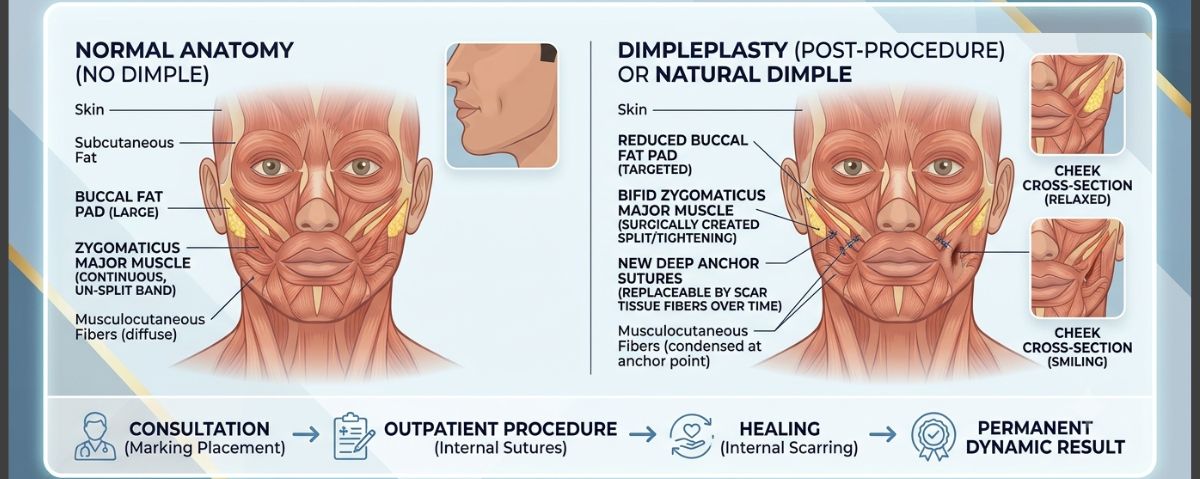
To understand why men get dimples, you have to look past gender and look directly at muscular anatomy. A natural cheek dimple is the result of an anatomical variant involving the zygomaticus major muscle. In most people, this muscle runs in a single, continuous band from the cheekbone to the corner of the mouth, pulling the lips upward when you smile.
In individuals born with dimples, this muscle splits into two distinct bundles – a condition known as a bifid zygomaticus major muscle. When a person smiles, the skin overlying this split is pulled inward toward the underlying connective tissue, creating a visible depression. This structural variation is entirely genetic and occurs equally in both men and women.
What Happens During a Male Dimple Surgery Appointment with Dr. Hirra Alavi?
One of the main reasons dimple creation surgery has surged in popularity among male professionals is its sheer simplicity. It is an entirely outpatient procedure. There is no hospital admission, no general anaesthesia, and no overnight stay required. You walk into the clinic, have the procedure done, and walk out shortly after.
Full Appointment Timeline
A standard clinical appointment for a male patient breaks down into precise, manageable phases:
- Consultation and Marking (10–15 Minutes): Hirra reviews your medical history, examines your facial muscle movement, and manually marks the exact depth and placement of the intended dimple while you smile and relax.
- Anaesthesia Application (10 Minutes): A local anaesthetic is injected directly into the inner cheek lining. This completely numbs the target area.
- The Procedure (20–30 Minutes): The plastic surgeon, Dr. Hirra, performs the internal incisions and places the structural sutures to create the dimple anchor.
- Post-Procedure Monitoring and Instructions (15 Minutes): The clinical staff checks the early response, provides oral hygiene instructions, and hands over your aftercare guidelines.
In total, your clinic time ranges between 60 to 75 minutes.
Techniques for Creating Dimples on Men: A Comparison
Male facial anatomy differs from female anatomy in skin thickness, subcutaneous fat distribution, and underlying muscle density. A standard, assembly-line approach will not work. A skilled surgeon must adjust their approach to match your specific facial measurements.
There are three primary dimpleplasty techniques men can consider, each yielding different levels of definition and permanence:
- Suture-Only Technique: A minor intervention where a surgical thread is passed through the inner cheek to catch the underside of the skin, pulling it inward. No tissue is excised. (Longevity: May fade or disappear over several months to a year as tissues adapt. Best Suited For: Men who want a very subtle, temporary trial run of a dimple with zero tissue alteration.)
- Punch Excision + Suture: The standard approach. A tiny, circular punch tool removes a minute piece of the inner cheek muscle or buccal fat before a heavy-duty absorbable suture locks the skin to the muscle layer. (Longevity: Highly durable and long-lasting; creates a permanent structural anchor. Best Suited For: The vast majority of male patients seeking a distinct, natural-looking dimple.)
What Results Can Men Expect from Dimple Surgery?
Managing expectations is the secret to a highly satisfying aesthetic outcome. When you leave the clinic, your face will not instantly display a perfectly subtle smile-triggered dimple. The tissue needs time to adapt to its new internal anchor.
Here is the exact week-by-week timeline of your expected male dimple surgery results:
Week 1–2: The Static Phase
During the initial fortnight, the dimple will be visible at rest. This means even when your face is completely expressionless, the indentation will be apparent. Minor swelling, localized firmness, and mild tenderness are completely normal. The dimple will look deeper and more pronounced than your final intended result.
Week 3–6: The Transition Phase
As the swelling subsides and the internal tissues begin to heal around the suture, the indentation relaxes. The dimple starts transitioning from an always-visible crater to an expression-triggered feature. It will still look slightly sharp when you laugh, but it will begin to soften when your face is at rest.
Week 8–12: The Mature Phase
By the third month, the internal absorbable suture has dissolved, leaving behind a natural band of scar tissue (a fibrous adhesion) that connects the skin to the muscle. The dimple now behaves exactly like a natural one: it is invisible when your face is relaxed and appears dynamically only when you smile or speak.
Factors Influencing Your Long-Term Look
Your unique facial attributes heavily dictate how your dimple settles over time:
- Skin Thickness: Men with thicker skin or coarser facial hair structures may require a slightly deeper internal anchor to show definition.
- Cheek Volume: If you have high facial fat levels, the dimple may appear deeper; if you have lean, hollow cheeks, the surgeon must use a lighter hand to prevent a gaunt appearance.
- Aging and Weight Changes: While the structural scar tissue band is permanent, massive weight fluctuations or natural skin laxity over decades can subtly alter the depth and positioning of the dimple.
Risks and Side Effects of Male Dimple Surgery
Like any cosmetic intervention involving an incision, Dimpleplasty risks men should know about exist, though they are statistically low when handled by a qualified professional. Understanding the difference between normal healing side effects and genuine clinical complications keeps you safe.
Normal Healing Effects (Not Complications)
- Mild swelling and bruising on the outside of the cheek.
- A tight or pulling sensation when opening your mouth wide.
- A clean, white healing film over the internal incision line inside your mouth.
Potential Clinical Risks
- Infection: Because the mouth is full of natural bacteria, the internal incision carries a slight infection risk. This is easily managed with prescribed antibiotic mouthwashes. Signs of a true infection include worsening pain after day four, foul-smelling discharge, or a sudden fever.
- Asymmetry: If the surgeon miscalculates the placement or if one side heals faster than the other, the dimples may look uneven. This is almost always a marking or execution issue rather than a biological anomaly.
- Persistent Resting Dimple: In rare instances, the internal tether is tied too tightly, causing the dimple to remain permanently stuck in the “on” position even after six months. A minor corrective procedure can release the tension.
- Dimple Fading: If the internal suture snaps prematurely or if the body fails to create a strong enough scar tissue bond, the dimple can fade away entirely within a few months.
- Scarring Inside the Mouth: While there is zero external scarring on your face, a small lump of internal scar tissue forms inside the cheek. This is a normal part of the process, but excessive scar formation can feel like a small hard bead inside your cheek for a few months before softening.
To mitigate these risks completely, avoid under-the-counter beauty clinics. Choosing a board-certified, PMDC-registered plastic surgeon with dedicated facial surgery experience makes certain that the correct depths are maintained without damaging the parotid duct or crucial facial nerves.
Recovery After Male Dimple Surgery: What to Expect
The male dimple surgery recovery period is remarkably swift, allowing most men to maintain their privacy regarding the procedure. Because the entire wound is hidden inside your mouth, there are no telltale bandages or external stitches to explain to coworkers.
The Recovery Timeline
- Day 1: Expect mild soreness. Stick to a soft, cool diet (smoothies, yogurt, cold soups) to avoid irritating the inner cheek line. Begin using your prescribed antiseptic oral rinse after every meal.
- Days 2–4: Swelling usually peaks on day two or three before receding. Most men return to their remote or desk-bound work schedules by day two. You can speak normally, though heavy laughing might feel a bit tight.
- Days 5–7: Light physical activities can be resumed. However, you must avoid heavy weightlifting, intense gym sessions, or contact sports that risk a blow to the face for at least a full week.
- Weeks 2–4: The internal stitches dissolve on their own. You can fully return to a regular diet, though hard, crunchy foods should still be chewed carefully on the opposite side of the mouth.
Beards, Shaving, and Facial Hair
A common question among male patients is, “Can I keep my beard, and when can I shave?”
Because the surgical access point is completely internal (inside the mouth), there are absolutely no restrictions on your external facial hair. Bearded men do not need to shave before the procedure. You can maintain your regular grooming, trimming, and shaving routines from day one without any risk of disrupting the surgical site or causing infection, provided you do not pull or manipulate the cheek tissue aggressively.
Myth-Busting: Addressing Male Hesitation Around Cosmetic Surgery
Even men who desperately want a more defined smile often hesitate due to outdated social stigmas. Let’s break down the most common myths keeping men out of the clinic.
Myth 1: “Cosmetic procedures are only for women.”
The modern aesthetic landscape in Pakistan has shifted dramatically. Men now account for a massive percentage of hair transplants, jawline contouring, and rhinoplasties. Taking control of your facial symmetry and structure is a standard aspect of modern self-care and professional presentation.
Myth 2: “Everyone will know I had work done.”
Because there are zero external incisions, there are no scars on your face to give the procedure away. Once the initial two-week static healing phase passes, the dimple integrates into your natural expressions. People will notice that your smile looks more engaging, but they will rarely guess a surgical procedure was involved unless you tell them.
Myth 3: “It will make my face look too soft or feminine.”
A skilled surgeon understands how to craft a dimple that brings out masculine features. By adjusting the placement to be slightly sharper, lower, or completely unilateral, the result adds rugged definition to a strong jawline rather than softening your appearance.
Ready to Redefine Your Smile?
Male dimple surgery is a minor, highly predictable outpatient procedure that can dramatically beautify your facial character. The hesitation surrounding it is entirely cultural, not medical. If dimple creation surgery in Lahore is something you are seriously considering, book a consultation with Dr. Hirra Alavi today to get started.
To Book your Consultation call +92 332 839 9983
____________________
Practitioner’s Authority
Meet Dr. Hirra Alavi – Consultant Plastic and Reconstructive Surgeon in DHA Lahore.
Dr. Hirra Alavi is a Consultant Plastic & Reconstructive Surgeon in DHA Lahore, a graduate of King Edward Medical University with an FCPS (Plastic Surgery) from CPSP. She achieved 1st position in Punjab in PPSC Senior Registrar interviews. Trained at Mayo Hospital, Lahore, she offers expertise in aesthetic surgery (rhinoplasty, blepharoplasty, fat grafting, and breast augmentation), reconstructive surgery, burns, and non-surgical treatments (Botox, fillers, lasers, and hair restoration). Her approach combines advanced techniques with compassionate, patient-centred care for natural-looking results.
____________________
DISCLAIMER
This article is for informational and educational purposes only. It is not intended to provide diagnosis, treatment, or medical advice. For any medical concerns, please consult a Licensed Practitioner.
____________________
References
Al-Hassany, A., and Al-Taie, A. (2021). Buccal dimpleplasty: Analysis of a simplified surgical technique and long-term patient satisfaction. Journal of Cranio-Maxillofacial Surgery, 49(8), 692–697.
Bao, Y., and Li, S. (2019). Anatomical variations of the zygomaticus major muscle and their clinical implications in dimple creation surgery. Aesthetic Plastic Surgery, 43(3), 654–661.
Khan, M. A., and Jamil, R. (2023). Rising trends in male facial aesthetics: A retrospective study of dimpleplasty outcomes in Pakistan. Pakistan Journal of Medical Sciences, 39(2), 411–415.