7 Things Every Pakistani Should Know Before Rhinoplasty in Lahore
July 27, 2026
Open and closed rhinoplasty are two surgical approaches to reshaping the nose, and the difference between them comes down to how the surgeon reaches the nasal structures. Closed (endonasal) rhinoplasty places every incision inside the nostrils. Open rhinoplasty adds one more incision, across the columella, which is the strip of tissue between the nostrils, so the skin can be lifted for a direct view of the cartilage and bone underneath (ASPS). Neither technique is right for every nose. A 2025 systematic review and meta-analysis found no significant overall difference in swelling, satisfaction, or complication rates between the two approaches and concluded that the choice should be based on the patient’s anatomy, the surgical goals, and the surgeon’s experience (PRS Global Open, 2025).
What Is Open Rhinoplasty?
Open rhinoplasty gets its name from how much of the nose’s internal framework the surgeon can actually see during surgery. In addition to incisions hidden inside each nostril, the surgeon makes one small incision across the columella, which is the tissue bridge between the nostrils (ASPS). This lets the skin covering the nasal bones and cartilage be lifted and folded back, exposing the underlying structure directly.
That level of exposure isn’t necessary for every case, but it matters when a surgeon needs to see exactly how cartilage segments line up, measure asymmetry precisely, or place and secure a graft. It also serves as a useful teaching setting, since trainees can observe the anatomy directly rather than working by feel (Rhinoplasty Archive).
Having better visibility doesn’t automatically mean a better outcome. Instead, it means a different set of trade-offs, covered below.
What Is Closed Rhinoplasty?
Closed rhinoplasty, which is also called the endonasal approach, keeps every incision inside the nostrils. There’s no columellar incision and no lifting of the skin off the nasal framework as a single unit. Instead, the surgeon works through small openings inside each nostril, reaching the cartilage and bone from underneath the skin without fully exposing it (ASPS).
Because the skin envelope stays largely intact, closed rhinoplasty can be well suited to primary cases involving more limited changes, such as reducing a dorsal hump, refining the tip modestly, or narrowing the nasal bones. It gives the surgeon less direct visualization than the open approach, so it tends to be chosen when the planned changes don’t require extensive restructuring or grafting.
Open vs Closed Rhinoplasty: Key Differences
| Factor | Open Rhinoplasty | Closed Rhinoplasty |
| Incisions | Inside the nostrils + columella | Inside the nostrils only |
| External incision | Yes, small columellar incision | No |
| Direct visualization | Greater | More limited |
| Surgical access | More extensive | More limited |
| Complex structural work | Often useful | Can be more difficult |
| Revision cases | Frequently used for complex revisions | Sometimes used for selected minor revisions |
| External scar | Small columellar scar possible | No external columellar scar |
| Recovery | Varies by case | Varies by case |
| Best suited for | Depends on anatomy and surgical goals | Depends on anatomy and surgical goals |
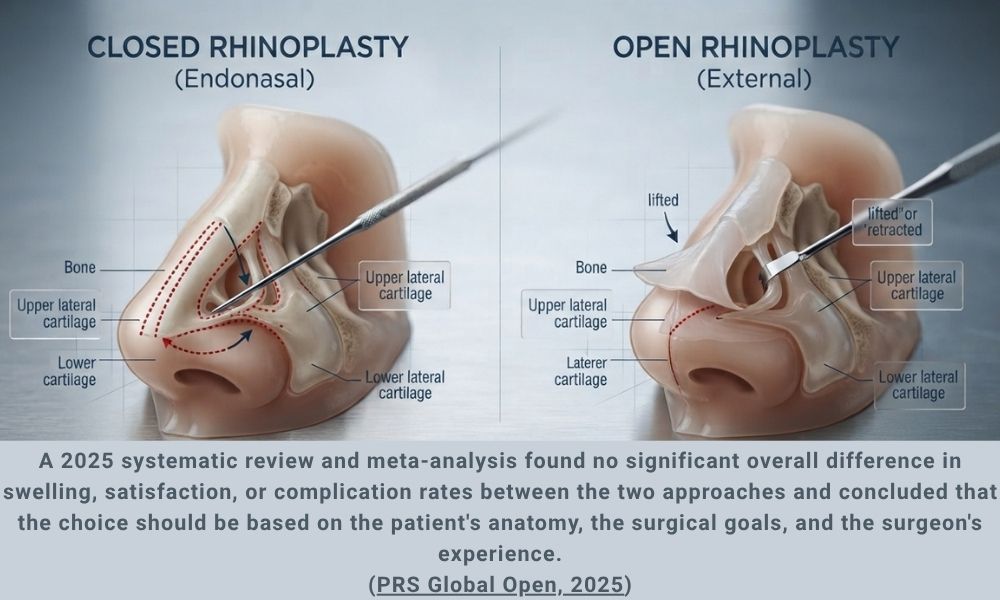
It’s tempting to look at a table like this and assume the extra incision in open rhinoplasty means more swelling or a slower recovery. That’s not what the best current evidence shows. A 2025 systematic review and meta-analysis pooling multiple studies found no statistically significant difference between the two approaches in postoperative edema, bruising, operative time, patient satisfaction, or complication rates (PRS Global Open, 2025). On the whole, the two techniques are more alike in outcome than the incision alone might suggest.
What Are the Advantages of Open Rhinoplasty?
Greater Surgical Visibility
Lifting the skin off the nasal framework gives the surgeon a direct, three-dimensional view of the cartilage, bone, and how they relate to each other, rather than assessing them by feel through a smaller opening.
More Access for Structural Changes
That visibility translates into more room to work when a case calls for reshaping cartilage, placing grafts, or correcting significant asymmetry. Procedures involving substantial rebuilding of the nasal framework often benefit from the added exposure.
Useful in Complex or Revision Cases
Open rhinoplasty is frequently favoured for post-traumatic deformities, significant asymmetry, and revision surgery, where the anatomy may already be distorted from prior surgery or injury, and precise visualisation helps avoid further complications (Rhinoplasty Archive).
None of this makes open rhinoplasty the “better” technique in a general sense; rather, it’s an advantage that matters most when the surgical goals actually require that level of access.
What Are the Advantages of Closed Rhinoplasty?
No External Columellar Incision
Because every incision stays inside the nostrils, there’s no cut across the columella to heal.
Limited External Scarring
Without a columellar incision, there’s no external columellar scar to manage during healing. Its a meaningful consideration for patients focused on minimising visible marks.
May Be Appropriate for Selected Primary Rhinoplasty Cases
Patients having their first rhinoplasty with relatively straightforward goals, such as modest hump reduction, mild tip refinement, or narrowing the bridge, may be good candidates for a closed approach, depending on their anatomy and their surgeon’s assessment and experience with the technique.
Is Open or Closed Rhinoplasty Better?
Neither approach is universally better. Both can produce satisfactory functional and aesthetic results, and the research comparing them directly has not found a consistent overall advantage for one over the other.
The most substantial evidence on this question is a 2025 systematic review and meta-analysis that pooled data across multiple studies comparing open and closed rhinoplasty. It found no significant difference between the two approaches in rhinoplasty outcome scores, nasal obstruction symptom scores, postoperative swelling and bruising, operative time, patient satisfaction, or complication rates. The authors’ conclusion was straightforward: the two techniques show similar efficacy, and the choice should be tailored to the patient and the surgeon’s expertise rather than treated as a fixed rule (PRS Global Open, 2025).
In practice, that means the right approach for you isn’t determined by which one sounds more advanced or more conservative. It comes down to your nose, your goals, and what Dr. Alavi is trained to do well.
When Might a Surgeon Choose Open Rhinoplasty in Lahore?
A surgeon may lean toward an open approach when:
- The nose has significant asymmetry that’s easier to correct under direct view.
- The case involves a complex structural deformity, such as one caused by trauma.
- Major reshaping or reconstruction of the nasal tip is planned.
- Cartilage grafts need to be placed and secured precisely.
- The surgery is a revision of a prior rhinoplasty, particularly a complex one.
- The nasal framework needs more extensive modification overall.
- The goals include both cosmetic and functional (breathing-related) reconstruction.
These are situations where Open Rhinoplasty in Lahore is often considered, not a checklist that automatically applies. Dr Alavi will weigh your specific anatomy before recommending it.
When Might a Surgeon Choose Closed Rhinoplasty in Lahore?
A closed approach may be well suited to:
- A first-time (primary) rhinoplasty with relatively modest goals
- Less extensive structural changes overall
- Certain dorsal modifications, like smoothing a hump
- Subtle tip refinements that don’t require extensive repositioning
- Cases where the surgeon judges that an internal approach gives adequate access to achieve the planned changes
As with open rhinoplasty, these are common scenarios rather than firm rules. The right call depends on what Dr Alavi sees during your evaluation.
Do read: 7 Things Every Pakistani Should Know Before Rhinoplasty in Lahore
Open vs Closed Rhinoplasty Recovery
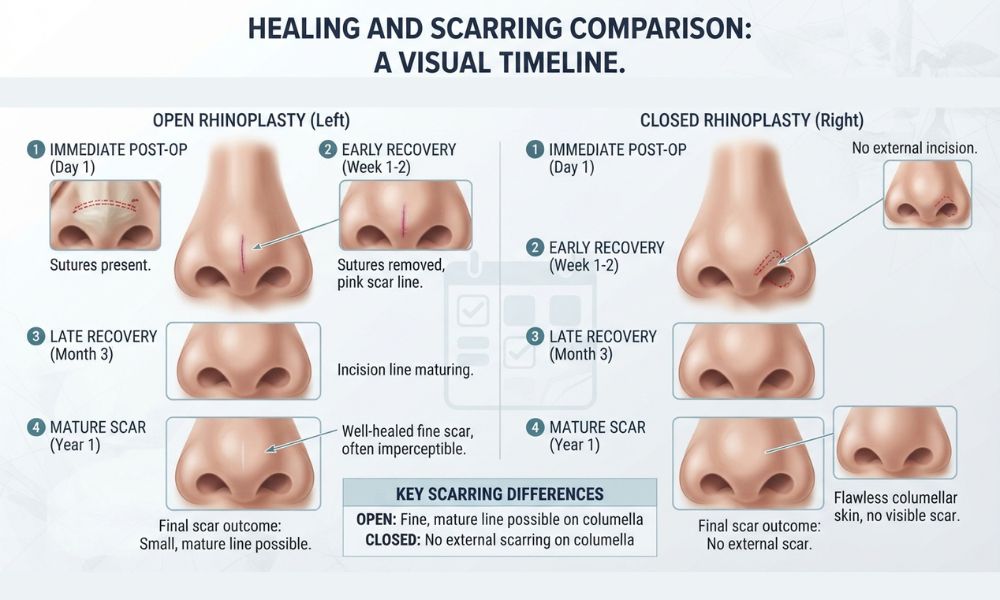 Recovery follows a broadly similar pattern regardless of technique. Most patients have a splint on the nose for about a week, along with swelling, bruising around the eyes, and nasal congestion in the first several days (ASPS). Breathing through the nose can feel temporarily restricted while swelling settles, and most people return to work or school within one to two weeks, though Dr Alavi will give you a timeline specific to your case.
It’s a common assumption that closed rhinoplasty heals faster because it involves one fewer incision. However, the 2025 meta-analysis discussed above found no significant difference in postoperative edema or bruising between the two approaches when measured at the same point after surgery (PRS Global Open, 2025). Individual healing, along with the extent of the surgery itself, tends to matter more than which incision pattern was used.
Visible swelling improves over the first few weeks, but the nose continues to refine gradually. According to ASPS, it can take up to a year for the final nasal contour to fully settle (ASPS).
Does Open Rhinoplasty Leave a Scar?
Yes. Because open rhinoplasty includes an incision across the columella, it does leave a scar in that location. Surgeons typically use a small, irregular incision pattern, such as an inverted V rather than a straight line, positioned to minimise tension and reduce the chance of a visible line as it heals (Rhinoplasty Archive). For most patients, the resulting scar fades and becomes difficult to notice at normal viewing distance, but healing varies from person to person, and it isn’t accurate to promise a scar-free result.
Closed rhinoplasty doesn’t involve this incision at all, since every cut is made inside the nostrils. That’s the clearest, most consistent difference between the two techniques in terms of visible scarring.
Can Both Open and Closed Rhinoplasty Improve Breathing?
Yes, both approaches can be used when part of the goal is functional, not just cosmetic. Nasal breathing problems often come from a structural cause: a deviated septum, where the cartilage wall between the nostrils is off-centre (Cleveland Clinic), or nasal valve collapse, where the airway narrows at one of two points along the side of the nose and is one of the most common structural causes of nasal obstruction (Cleveland Clinic).
It’s worth distinguishing cosmetic rhinoplasty (reshaping the nose’s appearance) from functional rhinoplasty (addressing a breathing problem), since many patients want both addressed in the same surgery, and either the open or closed technique can be used depending on what the septum and nasal valves need. Studies comparing the two approaches using the NOSE score, a validated questionnaire for nasal breathing symptoms, have not found a significant overall difference in functional improvement between them (PRS Global Open, 2025).
How Does a Surgeon Decide Which Approach to Use?
Patient’s Anatomy
The shape of your nasal bones and cartilage, your skin thickness, and any existing asymmetry all factor into which approach gives the surgeon what they need to work with.
Surgical Goals
Whether you’re mainly looking for a cosmetic change, addressing a breathing problem, or both affects how much access the surgeon needs.
Complexity of the Procedure
Simple reshaping is different from an extensive rebuild of the nasal framework. More involved reconstructions, along with revision surgery on a nose that’s already been operated on, often call for greater exposure.
Surgeon Experience
Training and familiarity with a given technique matter. Dr Alavi’s experience with both open and closed rhinoplasty means she can recommend whichever approach fits your case best, rather than defaulting to one technique regardless of your anatomy.
Current reviews of the evidence support this individualised approach rather than a universal preference for one technique (PRS Global Open, 2025).
Talk to Dr Hirra Alavi About Your Rhinoplasty
Call 0332-8399983 to arrange an appointment with Dr Alavi. During your consultation, she’ll evaluate your nasal anatomy, talk through your goals, walk you through whether an open or closed approach fits your case, and discuss rhinoplasty cost based on your treatment plan.
__________________
Meet Dr Hirra Alavi – Consultant Plastic and Reconstructive Surgeon in DHA Lahore.
Dr Hirra Alavi is a Consultant Plastic & Reconstructive Surgeon in DHA Lahore, a graduate of King Edward Medical University with an FCPS (Plastic Surgery) from CPSP. She achieved 1st position in Punjab in PPSC Senior Registrar interviews. Trained at Mayo Hospital, Lahore, she offers expertise in aesthetic surgery (rhinoplasty, blepharoplasty, fat grafting, and breast augmentation), reconstructive surgery, burns, and non-surgical treatments (Botox, fillers, lasers, and hair restoration). Her approach combines advanced techniques with compassionate, patient-centred care for natural-looking results.
__________________
Disclaimer
The information in this article is provided for general educational purposes only and does not constitute medical advice. It is not intended to replace a one-on-one consultation with a qualified plastic and reconstructive surgeon. Every patient’s nasal anatomy, health history, and surgical goals are different, and outcomes, risks, recovery timelines, and costs discussed here will vary from person to person.
Reading this article is not a substitute for an in-person medical examination. Decisions about rhinoplasty or any surgical procedure should be made only after a direct consultation with Dr Hirra Alavi or another licensed, board-certified surgeon who can assess your individual case. Dr Hirra Alavi’s clinic does not guarantee specific results, and no content on this page should be interpreted as a promise of outcome.
If you are experiencing a medical emergency, including breathing difficulty, uncontrolled bleeding, or signs of infection after a surgical procedure, seek immediate medical attention or contact emergency services rather than relying on information from this article.
__________________
References
Rhinoplasty Procedure Steps. American Society of Plastic Surgeons.
What to Expect During Your Rhinoplasty Recovery. American Society of Plastic Surgeons.
Rhinoplasty Recovery. American Society of Plastic Surgeons.
Deviated Septum: Symptoms, Causes & Treatment. Cleveland Clinic.
Nasal Valve Collapse: Symptoms, Causes, Test & Treatment. Cleveland Clinic.